
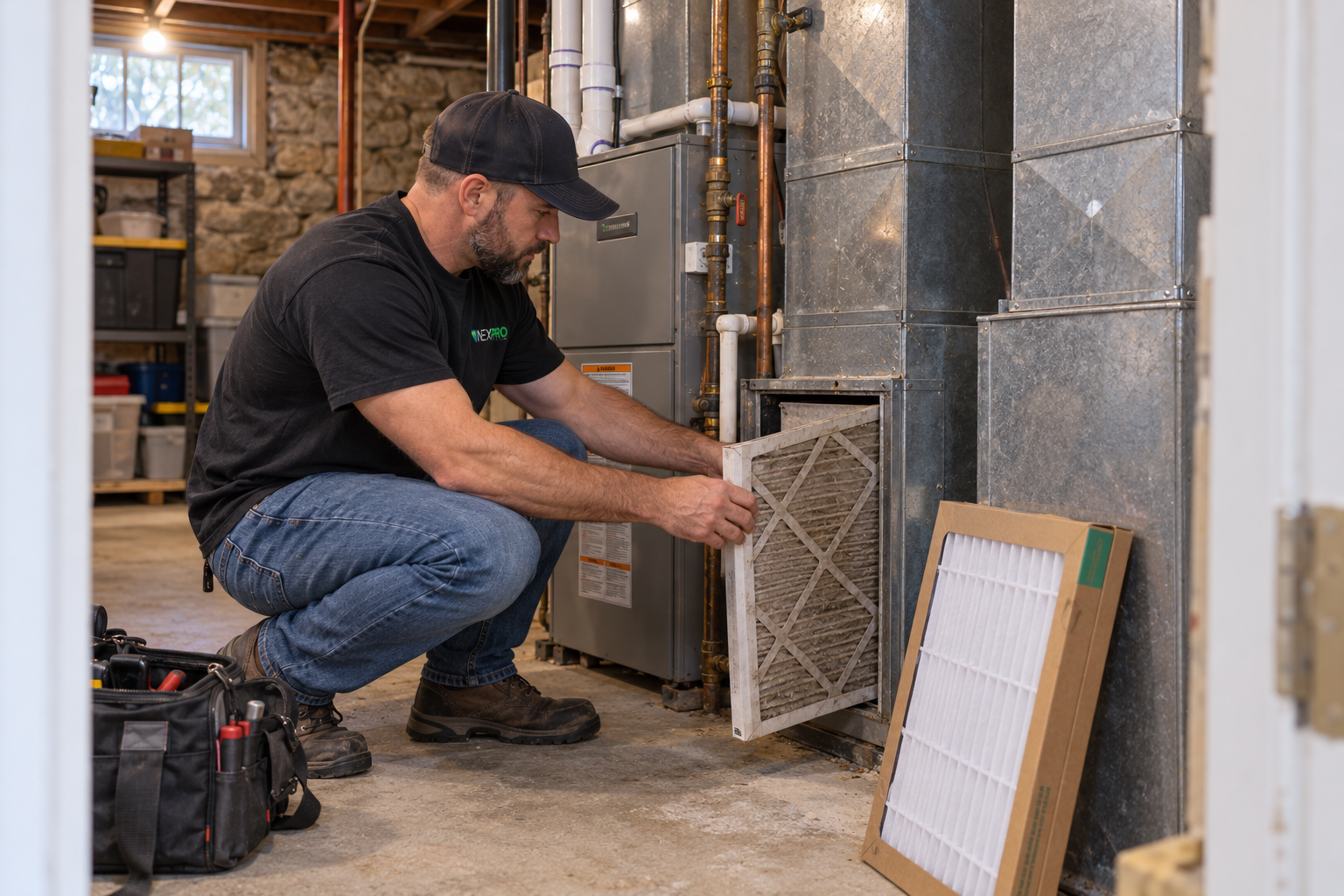
You turn up the thermostat, expecting your heating system to start warming the house. The furnace makes a few noises, maybe clicks or hums, but the burners never light. Minutes later, your home is still cold.
If your gas furnace won't ignite, the problem could involve several different components, from the electronic ignitor to the gas supply, safety controls, or furnace control board. The good news is that an ignition failure doesn't automatically mean your entire furnace needs to be replaced. Many furnace ignition problems involve individual components that can be inspected, tested, and potentially repaired.
However, because ignition involves natural gas, electrical components, and combustion safety systems, proper diagnosis is essential. For homeowners in Newton, MA, and surrounding communities, this guide explains how furnace ignition works, what a qualified HVAC technician should check, and when professional furnace repair is necessary. At NexPro HVAC & Plumbing, our approach is straightforward: repair first, replace only when it makes sense.
Quick Answer: Why Won't My Gas Furnace Ignite?
A gas furnace may fail to ignite because of a defective ignitor, interrupted gas supply, malfunctioning gas valve, thermostat issue, blocked vent, faulty pressure switch, or electrical control problem. If the burners light briefly and then shut off, the issue may instead involve flame detection or another safety-related condition. The most effective approach is to identify which stage of the furnace's startup sequence is failing. A qualified HVAC technician can inspect the ignition system, evaluate the safety controls, and determine whether a component can be safely repaired or replaced.
How Does a Gas Furnace Ignition System Work?
Understanding the basic ignition process helps explain why different failures can produce similar symptoms. Most modern gas furnaces use electronic ignition systems rather than continuously burning pilot lights. Although the sequence varies by manufacturer and model, a typical modern gas furnace starts heating through several stages:
If a required step fails, the furnace may interrupt the startup sequence to protect the equipment and occupants. That's why a furnace that won't ignite should be diagnosed systematically instead of having parts replaced based on guesswork.
What a Technician Should Check When a Furnace Won't Ignite
1. Is the Thermostat Actually Calling for Heat?
Before investigating the ignitor or gas valve, a technician should verify that the furnace is receiving the correct heating request. Sometimes an apparent ignition problem begins with the thermostat. Potential causes include incorrect thermostat settings, faulty temperature sensors, loose low-voltage wiring, thermostat power problems, incorrect system configuration, or communication problems between the thermostat and furnace.
What should a technician check? The technician should confirm that the thermostat is requesting heat and that the furnace receives the appropriate control signal. If the furnace never receives a valid heating request, it may not begin its ignition sequence at all.
Can it be repaired? Often, yes. The solution may involve correcting settings, repairing wiring, or replacing a malfunctioning thermostat. There is no reason to replace an otherwise functioning furnace because of an isolated thermostat problem.
2. Is the Furnace Ignitor Working Properly?
A failed ignitor is one potential reason a modern gas furnace won't light. Hot surface ignitors are designed to reach a temperature sufficient to ignite the gas supplied to the burners. These components experience repeated heating and cooling cycles during normal furnace operation. Over time, an ignitor may develop damage or an electrical failure that prevents proper operation.
Signs of a possible bad furnace ignitor:
- The furnace receives a heating request but never lights.
- The startup sequence begins without producing heat.
- The furnace makes repeated ignition attempts.
- The system enters an ignition lockout.
- The ignitor fails to activate as expected.
Not every furnace uses a visibly glowing ignitor. Spark ignition systems operate differently, and a lack of visible glow alone does not establish that the ignitor has failed.
Does a bad ignitor mean the furnace needs replacement? Usually not. If a failed ignitor is the confirmed problem and a compatible replacement is available, the component can often be replaced without changing the entire heating system. However, the furnace should be tested after repair to confirm safe, consistent ignition.
3. Is the Gas Supply Reaching the Furnace?
Even a properly functioning electronic ignitor cannot light the burners without an adequate fuel supply. A furnace may fail to ignite because gas is unavailable or cannot be delivered under the required operating conditions. Possible causes include an interruption in utility gas service, a closed gas shutoff valve, insufficient gas pressure, a malfunctioning gas valve, or a problem with the furnace's gas controls.
What should a technician check? A qualified professional may evaluate whether fuel is available and whether the furnace's gas controls and supply conditions meet the manufacturer's requirements. Gas pressure testing and gas-valve evaluation must be performed with appropriate equipment and safety procedures.
Can a gas supply problem be repaired? It depends on the cause. An issue involving a service interruption may require contacting the utility company, while a defective furnace gas valve may be replaceable. Gas-related repairs should never be attempted through DIY adjustments to valves, fittings, regulators, or burner components.
If you smell natural gas or suspect a gas leak, leave the building immediately. Do not operate electrical switches or equipment. Call 911 from a safe outdoor location.
4. Is the Furnace Flame Sensor Working Correctly?
The flame sensor is frequently mentioned when homeowners search for furnace ignition problems. However, it is important to understand the difference between a furnace that never lights and one that lights but won't stay on. A flame sensor does not normally initiate ignition. Instead, it helps the furnace control confirm that the burners have successfully ignited. If the control system cannot detect the expected flame signal, it may shut off the gas valve.
Signs of a flame-detection problem:
- Burners ignite but shut off shortly afterward.
- Furnace repeatedly attempts to start.
- The system produces heat briefly before shutting down.
- An ignition-related fault code appears.
- The furnace eventually enters a protective lockout.
Can a flame sensor be repaired? In many cases, professional cleaning or replacement may resolve a confirmed sensor problem. However, weak flame signals can also result from other issues. Replacing the flame sensor without verifying the cause may leave the original problem unresolved.
5. Is a Pressure Switch or Venting Problem Preventing Ignition?
Modern gas furnaces rely on safety systems to verify appropriate combustion and exhaust conditions. On many induced-draft furnaces, a pressure switch is part of the process that verifies whether the draft system is operating under acceptable conditions. If the furnace cannot establish the required conditions, ignition may be prevented.
Potential causes:
- Blocked exhaust piping
- Restricted combustion-air intake
- Inducer motor problems
- Condensate drainage blockages
- Defective pressure-sensing components
- Problems with related tubing, wiring, or controls
High-efficiency gas furnaces may be particularly sensitive to condensate drainage problems because they produce water during normal operation. During Massachusetts winters, snow and ice can also obstruct outdoor intake or exhaust terminations.
Can this problem be repaired? Many venting and condensate-related faults can be corrected. However, venting problems must be handled carefully because improper combustion exhaust can create carbon monoxide hazards. Never bypass a pressure switch or attempt to force ignition when a venting-related safety control prevents operation.
6. Is the Furnace Control Board Sending the Correct Signals?
A gas furnace relies on electronic controls to coordinate ignition, fuel delivery, flame detection, blower operation, and safety functions. If the control board malfunctions, the system may fail to complete the ignition sequence. For example, the furnace might receive a valid heating request but fail to activate another component required for startup.
Signs of a possible control problem:
- Furnace behaves inconsistently during startup.
- Ignition components do not activate when expected.
- Fault codes appear intermittently.
- Furnace repeatedly enters lockout.
- Heating works occasionally but fails at other times.
Does a failed control board require a new furnace? Not necessarily. Many furnace control boards are replaceable, depending on model compatibility, availability, and the condition of the equipment. A proper diagnosis helps avoid replacing an expensive electronic component unnecessarily.
7. Could an Airflow or High-Limit Safety Problem Stop Ignition?
Airflow problems are more commonly associated with overheating and interrupted heating cycles than with an initial failure to ignite. However, some safety conditions can also prevent a furnace from beginning another heating cycle. For example, a furnace that previously overheated may have activated a temperature limit or another protective control. Possible contributing conditions include dirty air filters, restricted return airflow, blocked supply registers, blower motor problems, ductwork restrictions, or other overheating conditions.
A technician should evaluate whether an active safety fault is preventing the system from operating. A tripped safety control should never be treated as an inconvenience to bypass. The reason for the safety shutdown must be identified and corrected.
8. Does Your Furnace Have an Older Pilot Light System?
Although many modern furnaces use electronic ignition, some older equipment relies on a standing pilot light. If your furnace has this design, ignition problems may involve components that are not present in newer systems. Potential issues include pilot flame failure, pilot assembly problems, thermocouple or pilot safety-control failure, gas supply problems, or draft-related issues.
What should a technician inspect? The technician should identify the ignition system installed, inspect the pilot assembly and associated safety components, and evaluate whether the system can operate safely. Homeowners should not assume that modern electronic ignition troubleshooting applies to an older pilot-light furnace. If the pilot repeatedly goes out, professional diagnosis is appropriate. Do not attempt to relight a gas furnace unless its manufacturer specifically permits homeowner relighting and there are no signs of unsafe operation. When uncertain, request professional service.
Gas Furnace Won't Ignite: What Different Symptoms May Mean
The way your furnace behaves during startup can provide useful diagnostic clues. These symptoms are starting points for diagnosis, not proof that a specific component has failed.
| Furnace symptom | Possible cause |
|---|---|
| Thermostat requests heat, but nothing happens | Thermostat, power, wiring, or control issue |
| Furnace starts its sequence, but burners never light | Ignitor, gas supply, or ignition-control problem |
| Ignitor activates, but burners do not ignite | Gas delivery or ignition-sequence problem |
| Burners ignite briefly and shut off | Flame-detection or combustion issue |
| Furnace attempts ignition repeatedly | Ignition failure or unresolved safety condition |
| Furnace displays an ignition fault code | Model-specific ignition or control problem |
| Inducer starts, but ignition never follows | Venting, pressure-switch, or control issue |
| Furnace stays off after repeated failures | Protective lockout or another active fault |
What Can Homeowners Safely Check When a Gas Furnace Won't Ignite?
Before scheduling service, homeowners can perform a few basic checks that do not involve accessing gas or combustion components.
Safe homeowner checklist:
- Check the thermostat. Confirm it is set to HEAT and the requested temperature is above the current indoor temperature.
- Check thermostat power. Replace batteries if applicable and the thermostat displays a low-battery warning.
- Verify furnace power. Check that the normal external furnace power switch is on.
- Check the circuit breaker. Look for a tripped circuit, but do not repeatedly reset a breaker that continues tripping.
- Inspect the air filter. Replace a dirty, accessible filter according to the manufacturer's instructions.
- Observe the startup pattern. Notice whether the furnace is completely silent, attempts ignition, or lights briefly and shuts off.
- Record visible fault codes. Note any codes shown on an accessible display without removing service panels.
- Confirm airflow pathways are unobstructed. Check accessible supply and return registers.
If these checks do not resolve the problem, contact a qualified HVAC professional. Do not attempt to test electrical components, open the gas valve assembly, disassemble burners, or bypass furnace safety controls.
If you smell natural gas, hear a suspected gas leak, or believe gas may be escaping, evacuate immediately. Do not use light switches, electrical devices, or appliances. Call 911 from outside the building. If a carbon monoxide alarm sounds, evacuate and contact emergency services. Never repeatedly attempt to force a furnace to ignite after an unexplained lockout.
What Should a Professional Furnace Ignition Diagnostic Include?
When a homeowner reports that a gas furnace won't ignite, the technician should approach the problem systematically. The diagnostic process may involve several areas depending on the equipment and symptoms.
- Identify the furnace and ignition system (hot surface, spark, or older pilot).
- Verify the heating request from the thermostat.
- Review stored or active fault codes using the manufacturer's documentation.
- Evaluate the startup sequence to determine which stage is failing.
- Check applicable ignition components, controls, and electrical circuits.
- Evaluate gas delivery and burner operation with professional testing.
- Inspect flame detection and safety controls without bypassing them.
- Confirm venting, condensate, and operating conditions.
- Verify operation after repair to confirm safe, consistent ignition.
Not every diagnostic appointment requires replacing parts. In some situations, the problem may involve settings, maintenance, or an operating condition that can be corrected without major equipment changes.
Can Furnace Ignition Problems Be Repaired Without Replacing the System?
Yes. Many furnace ignition problems can be repaired without replacing the entire heating system. The appropriate solution depends on which component or operating condition is responsible for the failure.
| Diagnosed problem | Possible repair | Full replacement? |
|---|---|---|
| Failed electronic ignitor | Replace compatible ignitor | No |
| Faulty flame sensor | Professional cleaning or replacement | No |
| Thermostat malfunction | Repair settings, wiring, or thermostat | No |
| Defective gas valve | Professional gas-valve replacement | Not necessarily |
| Control board failure | Replace compatible control board | Not necessarily |
| Condensate blockage | Correct drainage problem | Usually no |
| Venting restriction | Correct the obstruction or venting fault | Not necessarily |
| Major equipment deterioration | Evaluate safety and repair feasibility | Possibly |
A cracked or otherwise unsafe heat exchanger is a separate safety concern that may substantially change the repair-versus-replacement decision. Before replacing a furnace, a professional should consider the diagnosed failure, equipment condition, repair cost, replacement-part availability, and safe operating requirements. For a deeper look at that decision process, read our guide on gas furnace repair vs. replacement.
How Much Does Gas Furnace Ignition Repair Cost?
The cost of repairing a furnace that won't ignite depends on the source of the problem. Replacing a failed ignitor is different from repairing a control board or addressing a gas supply issue. Several factors influence the total cost:
- Furnace make and model
- Failed component
- Diagnostic labor
- Replacement-part availability
- Equipment age and condition
- Accessibility of the furnace
- Additional safety or operating problems
Because multiple components can cause an ignition failure, the symptom alone is not enough to establish an accurate repair price. A professional diagnosis helps homeowners understand what needs attention before committing to a major repair.
Gas Furnace Ignition Repair in Newton, MA
During Massachusetts winters, a furnace that fails to ignite can quickly affect household comfort. Homeowners in Newton and surrounding communities rely on dependable heating equipment during extended periods of cold weather. Whether the problem involves an electronic ignitor, flame sensor, gas control, or another component, accurate diagnosis is essential.
At NexPro HVAC & Plumbing, the emphasis is on evaluating the heating system and considering appropriate repair solutions before recommending replacement. Understanding why a furnace isn't lighting helps homeowners make better decisions about their equipment. For related troubleshooting, read our article on gas furnace not heating in Newton, MA and our guide on furnace turns on then shuts off.
How Can You Help Prevent Furnace Ignition Problems?
Not every ignition failure can be prevented, but regular heating maintenance can help identify some developing problems.
- Schedule annual furnace maintenance to identify worn ignition components and electrical concerns.
- Keep filters properly maintained to avoid airflow restrictions that trigger safety controls.
- Maintain appropriate venting conditions — keep accessible exterior intake and exhaust terminations clear.
- Address unusual startup behavior such as repeated ignition attempts or unexplained lockouts.
- Maintain working carbon monoxide alarms per Massachusetts requirements and manufacturer instructions.
Professional maintenance cannot guarantee that an ignitor or other component will never fail, but it can support more reliable and safer heating operation. Learn more about our preventive maintenance program.
Don't Replace Your Gas Furnace Before Diagnosing the Ignition Problem
A gas furnace that won't ignite can have several possible causes. The problem may involve the ignitor, gas delivery, flame sensor, furnace controls, venting, or another part of the heating sequence. Some of these conditions can be corrected through targeted repairs without replacing the entire furnace. The most important step is identifying the actual failure.
At NexPro HVAC & Plumbing, the goal is to diagnose the problem, explain the available options, and consider safe, practical repairs before recommending a new heating system.
Frequently Asked Questions About Gas Furnace Ignition Problems
Why won't my gas furnace ignite even though the thermostat is working?
The furnace may be receiving a heating request but failing during a later stage of startup. Possible causes include a defective ignitor, gas supply issue, malfunctioning control board, or safety condition preventing ignition.
How do I know if my furnace ignitor is bad?
Possible signs include failed ignition attempts, the absence of expected ignitor operation, and ignition-related fault codes. However, other problems can produce the same symptoms. A qualified technician should test the ignitor before recommending replacement.
Why is my furnace clicking but not lighting?
Clicking may be associated with the ignition sequence or electrical controls, depending on the furnace design. If the burners do not light, the problem may involve ignition, fuel delivery, or a safety-control issue.
Can a dirty flame sensor prevent my furnace from heating?
Yes. A dirty or faulty flame sensor may cause the control system to shut down the burners shortly after ignition. However, a flame sensor generally does not explain why an otherwise properly functioning furnace never begins ignition.
Can a gas furnace ignitor be replaced?
Yes. Many modern gas furnaces have replaceable ignition components. The correct replacement depends on the furnace make, model, ignition design, and manufacturer specifications.
Why does my furnace try to ignite several times and then stop?
The furnace may be entering a protective lockout after unsuccessful ignition attempts. This can happen because of ignition, gas supply, flame-detection, or other control-related faults. Repeated failures should be professionally diagnosed.
Can a bad pressure switch prevent furnace ignition?
Yes. On applicable furnace designs, the control system may prevent ignition when the required pressure-switch conditions are not satisfied. The underlying problem could involve the switch, venting, inducer operation, condensate drainage, or another related condition.
Is it safe to keep resetting a furnace that won't ignite?
No. Repeatedly resetting a furnace without identifying the cause can interfere with the intended response to an unresolved fault. If basic homeowner checks do not restore normal operation, request professional service.
Does a furnace that won't ignite need to be replaced?
Not necessarily. Many ignition failures involve individual components that may be repaired or replaced. Full furnace replacement should be considered based on the equipment's condition, safety, repair costs, and long-term reliability.
When should I call an HVAC technician for furnace ignition problems?
Contact a qualified technician when the burners repeatedly fail to ignite, the furnace enters lockout, heating is unreliable, or basic thermostat and power checks do not resolve the problem. Gas leaks and carbon monoxide alarms require immediate evacuation and emergency assistance.
Need Gas Furnace Ignition Repair in Newton, MA?
Start with a professional diagnosis, not an assumption that your entire furnace needs replacement. Contact NexPro HVAC & Plumbing to request an HVAC diagnostic appointment and discuss the repair options for your heating system.